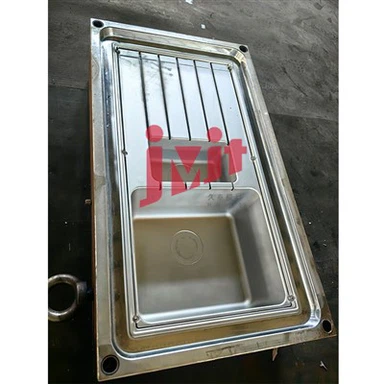
Melamine Basin Molds
Melamine washbasins , as a cost-effective alternative to ceramic and natural stone washbasins, have their final performance and service life directly determined by the design accuracy and manufacturing quality of the molds. This article will systematically analyze the technical value and...
- Fast Delievery
- Quality Assurance
- 24/7 Customer Service
Product Introduction
Melamine washbasins, as a cost-effective alternative to ceramic and natural stone washbasins, have their final performance and service life directly determined by the design accuracy and manufacturing quality of the molds. This article will systematically analyze the technical value and application logic of the melamine washbasin molds from Jiutai JMJT Mould Company from six dimensions: core advantages, functional roles, finished product effects, mold material selection, processing techniques,and industry trends.
(https://www.jiutaimould.net/)
I. Core Advantages: Balancing Practicality and Economy
The core advantages of the melamine washbasin molds from Jiutai JMJT Mould Company are concentrated in three dimensions:
Firstly, it has extremely strong shape adaptability and can precisely form various irregular shapes such as conical hats and ellipses. At the same time, it can accurately replicate wood grain, blue and white porcelain patterns and other texture qualities, effectively breaking through the technical bottlenecks of traditional ceramic molds in the mass production of irregular and textured products.
Secondly, it features outstanding structural durability. High-quality molds can stably withstand the repeated cycles of forming temperatures ranging from 120 to 140℃ and pressing pressures of 7 to 15 MPa. Under standard working conditions, the service life can reach over ten thousand times.
Thirdly, it has outstanding economic cost-effectiveness. The high versatility of the molds significantly reduces the mold change costs for multi-specification products. Combined with the cost advantage of melamine substrates, the unit price of finished washbasins can be reduced by about 30% compared to traditional ceramic washbasins, which is particularly suitable for the cost control needs of bulk purchasing scenarios such as hotels, chain restaurants, and budget hotels.

II. Core Function and Finished Product Effect: Empowering Product Value Upgrade
As the core tooling for melamine washbasin production, the mold's core functions are reflected in two key aspects: precise shape control and process compatibility, directly determining the quality of the finished product. On one hand, the precise cavity structure of the mold fixes the forming shape of melamine resin and quartz sand fillers, ensuring that the key dimensions of the washbasin have an error of less than 0.5mm, guaranteeing assembly compatibility. On the other hand, through the precise surface treatment technology of the cavity, the preset surface texture and texture details are accurately replicated. The quality of the mold is ultimately reflected in the finished product effect: washbasins produced by high-quality molds have a temperature resistance of up to 120°C, and their acid and alkali resistance fully complies with the GB 4806.6-2025 national food safety standard. The surface presents a dense structure without pores, making it easy to clean after oil stains adhere, and the surface patterns have excellent wear resistance and scratch resistance after being formed by mold pressing, fully meeting the durability requirements of high-frequency usage scenarios such as catering and hotels.

III. Mold Materials and Processing Procedures: Dual Assurance of Quality
The selection of mold materials and the control of processing procedures are the dual cores for ensuring mold quality. In terms of material selection, pre-hardened alloy mold steel (typical grades such as 718H) is the industry's first choice, with a base hardness of 30-35HRC. After surface nitriding treatment, the surface hardness can be increased to over 60HRC, effectively resisting the friction loss of melamine mixtures during high-pressure forming. For high-end custom molds, nano-coating technology is also used for surface treatment to further reduce the demolding resistance after forming and improve production efficiency. The processing procedures follow a rigorous process of "design - processing - strengthening - assembly - trial molding": first, the cavity structure is designed through CAD 3D modeling, then the cavity is milled by a CNC precision processing center to ensure dimensional accuracy; subsequently, the mold base hardness is strengthened through heat treatment, and the surface polishing accuracy needs to reach below Ra0.02μm; finally, the assembly of core components such as guide pins and temperature control systems is completed. After at least 3-5 trial mold adjustments to the forming parameters, it can be officially put into mass production. The entire processing cycle usually takes 15-20 days.

IV. Future Trends: Green and Intelligent Transformation
Under the dual drivers of tightened environmental policies and the intelligent transformation of manufacturing, the melamine washbasin mold industry is showing three clear development trends:
First, in terms of green upgrading, to meet the VOCs control and energy-saving requirements of the melamine industry, molds have begun to integrate precise temperature control and adjustment modules, enabling dynamic adaptation of the molding temperature. This results in energy savings of over 17% compared to traditional molds.
Second, intelligent transformation: By implanting pressure and temperature sensors at key positions in the mold cavity, real-time molding data is collected. Combined with AI algorithms, the pressing parameters are dynamically optimized, effectively enhancing the pass rate of finished products.
Thirdly, customization is deepening. In response to the personalized demands of the high-end home market, replaceable core molds are gradually becoming widespread, enabling the same production equipment to quickly switch between the production of different shaped basins, significantly enhancing the efficiency of customized production. At the same time, breakthroughs in melamine waste recycling technology (such as the supercritical water hydrolysis method, with a recovery rate of up to 72%) are promoting the development of mold-adaptive recycling material forming processes, further expanding the environmental value and application scenarios of melamine basins.
To sum up, the melamine washbasin molds produced by JMJT Mold Company have seen a continuous increase in market demand in the catering, home, and hotel sectors, thanks to their core advantages of flexible design, strong durability, and high cost-effectiveness. In the future, with the deep integration of green manufacturing technology and intelligent control systems, molds will not only serve as production tools but also become the core support for the upgrade of melamine products towards high-end, environmentally friendly, and customized features.

Hot Tags: melamine basin molds, China melamine basin molds manufacturers, factory, mould for natural materials, mould for integrated circuits, mould for printed circuit boards, mould for plastic bags, mould for dental products, mould for climbing products