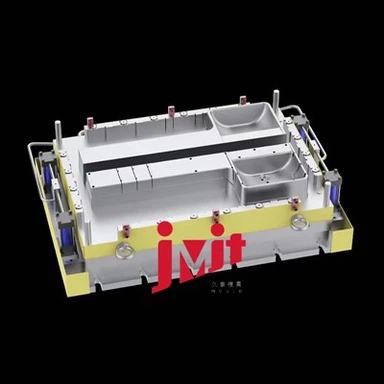
Washing Machine Integrated Basin Mold
In the current trend where the integration of the balcony and bathroom is becoming increasingly prominent, the integrated washing machine basin has emerged as the mainstream choice in the home market due to its core advantages such as "high space utilization, convenient installation, and...
- Fast Delievery
- Quality Assurance
- 24/7 Customer Service
Product Introduction
In the current trend where the integration of the balcony and bathroom is becoming increasingly prominent, the integrated washing machine basin has emerged as the mainstream choice in the home market due to its core advantages such as "high space utilization, convenient installation, and outstanding appearance". The mold, as the core carrier for the production of this product, its design precision, manufacturing process, and material performance directly determine the quality level, production efficiency, and market competitiveness of the final product. JMJT Mold takes you through five dimensions - advantages, core competitiveness, material selection, processing procedures, and future outlook - to deeply analyze the technical key points and industrial value of the mold for the integrated washing machine basin. https://www.jiutaimould.net/
I. Core advantages of the mold: Performance breakthroughs tailored to application scenarios
The core advantages of the integrated washing machine basin mold are concentrated in the dual breakthroughs of scene adaptability and production efficiency. From the perspective of space adaptation, the mold can precisely form the integrated structure of "washing machine embedded installation position + wash basin body", completely solving the gap problem of traditional split assembly products - after measurement, the waterproof sealing performance of the integrated formed product is over 40% higher than that of the split product, effectively avoiding the risk of water leakage on the balcony. In terms of production efficiency, the single-time forming qualification rate of high-quality molds can reach over 98%, with a standard service life exceeding 300,000 stamping cycles; compared to the split mold model that requires separate forming and then assembly, the production efficiency is directly increased by 50%, and the mold cost per unit product is reduced by approximately 30%, significantly enhancing the market pricing advantage of the enterprise.
In addition, the mold has strong personalized customization capabilities, which can flexibly adjust the depth of the basin (conventional 30-45 cm can be customized), the position of the drainage outlet (wall outlet/ground outlet switch), and the appearance design (square, round, or irregular shape); at the same time, it is combined with surface treatment processes such as polishing, sandblasting, and coating to achieve multiple textures such as matte, high gloss, and texture patterns, perfectly adapting to different modern minimalist, luxury, and new Chinese-style home design styles. This "standardized mold architecture + modular customization adjustment" balance ability has become the core competitiveness that distinguishes mold enterprises in the market.

II. Core competitiveness: Precision control and structural optimization capabilities
The core competitiveness of the mold lies in the "millimeter-level control" of product key performance, with precision control and structural optimization being the two core supports. In terms of precision control, the key dimensions of the mold cavity must be strictly controlled within ±0.02mm - this precision standard can ensure that the gap between the washing machine body and the basin installation position does not exceed 0.5mm, achieving a "perfectly tight" assembly effect; at the same time, the surface flatness error of the basin must be ≤0.1mm/m, fundamentally avoiding water residue problems. The realization of this precision requirement relies on advanced mold flow analysis technology: through CAE software such as Moldflow to simulate the entire process of melt flow, filling, and cooling in the mold cavity, optimize the number and position of gates, the layout density and cross-sectional dimensions of cooling water channels, and control the occurrence rate of shrinkage marks, melt joint marks, etc. to be below 2%.
Structural optimization focuses on improving the demolding efficiency and durability. For the composite structure of the integrated basin "basin + installation position", molds generally adopt "inclined guide pillar core pulling + slider linkage" mechanisms, which can achieve smooth demolding of complex cavities, with the uniformity of demolding force increasing by 40%, effectively preventing product warping deformation (deformation ≤ 0.3mm) due to uneven force distribution. In the durability design, in addition to using R3-R5 arc transitions at the corners of the mold cavity (to avoid stress concentration), the surface of the mold cavity will undergo nitriding treatment (hardness increased to HV800 or above), and the layout of the top pins (spacing ≤ 150mm) will be optimized to reduce local wear, ultimately achieving a positive cycle of "mold life extended by 20%, product scrap rate reduced by 1.5%".

III. Material Selection: Performance Adaptability Determines Mold Value
The selection of mold materials should be based on a triangular balance model of "processing performance, durability, and cost budget". Currently, the mainstream in the industry has formed three material systems:
The first type is the basic P20/718 pre-hardened steel, suitable for the production of one-piece plastic basins made of common plastics such as PP and ABS. The factory hardness has reached HRC28-32, and no subsequent quenching treatment is required. It has high processing efficiency and the unit price is only 25-35 yuan per kilogram. The single-use lifespan is stable and exceeds 300,000 times.
The second type is the high-end S136 mirror stainless steel. After undergoing vacuum quenching and deep cold treatment, its hardness is increased to HRC 45-50. The surface is polished to achieve a mirror finish with Ra 0.02 μm. It has excellent corrosion resistance (able to withstand the acidic demolding agent used during quartz stone molding), and is suitable for the high-pressure molding requirements of composite materials such as quartz stone and SMC. The service life can reach over 500,000 times, with a unit price of approximately 80-100 yuan per kilogram.
The third type is special H13 hot working die steel. It can maintain a hardness of HRC 40 or above at a temperature of 600℃. It has outstanding high-temperature wear resistance and is the exclusive choice for one-piece mold of SMC and BMC composite materials that require 150-180℃ high-temperature curing. Its service life exceeds 600,000 cycles.
The adaptability of the material directly determines the "success" or "failure" of the mold. Taking the production of quartz stone integrated basins as an example: the molding process needs to withstand a dual load of 160℃ high temperature and 850-1000 ton high pressure. Ordinary steel is prone to cavity collapse or surface scratches. Therefore, S136 steel that has undergone "forging + spheroidizing annealing" pre-treatment must be selected. By refining the crystal grains, the material density can be improved; at the same time, the surface of the cavity needs to undergo hard chrome plating treatment (with a thickness of 5-8 μm), which will increase the surface hardness to above HV1000, effectively solving the problems of sticking to the mold and wear caused by quartz sand particles, and ensuring the stability of the product molding quality.

IV. Processing procedures: Key links determine molding accuracy
Mold processing follows the core logic of "design determines direction, processing ensures accuracy, debugging determines success or failure", and requires more than ten procedures in four stages. Among them, three key links determine the final quality. The first is the digital design stage: using 3D software such as UG and ProE to build a 1:1 fully parametric model, and optimizing the cooling water channels through CAE mold flow analysis (usually using 8-12 mm spiral water channels) to ensure that the temperature difference in each area of the mold is ≤ 5℃, reducing product shrinkage and deformation; the second is the precision processing stage:
Using five-axis CNC machine tools for cavity surface milling, with positioning accuracy of ±0.005mm, and completing the molding of complex structures such as deep cavities and narrow slots through EDM electrical discharge machining (processing accuracy ±0.003mm), and the final surface roughness of the cavity needs to be below Ra0.8 μm; the third is the trial mold debugging stage: 3-5 rounds of trial molds need to be conducted, by adjusting injection molding temperature (plastic type 180-230℃, composite material 200-250℃), pressure (80-120 MPa), and holding pressure time, focusing on verifying the smoothness of demolding, product size accuracy (using a three-coordinate measuring instrument for detection), and surface defects, until the qualified rate of batch production stabilizes at over 98%.
For SMC (Sheet Mold Compound) integrated basin molds, an additional key step of mold preheating system debugging is required: The temperature of the upper and lower molds is controlled within a gradient range of 150-160℃ and 160-170℃ respectively using a mold temperature controller, ensuring that the material is fully cured within 2-3 minutes under a pressure of 850-1000 tons in the press; at the same time, the spraying amount of the release agent (0.5-1g per square meter) needs to be adjusted to ensure smooth demolding while avoiding residue that affects the surface texture of the product.

V. Future Outlook: Intelligence and Greening Leading Upgrades
In line with the development trend of the bathroom industry towards "intelligence, greenness, and high-endization", mold technology will accelerate its upgrade in three major directions:
One is the innovation of intelligent production: The integration of CAD/CAE/CAM digital twin system is introduced to achieve full-process digitalization of mold design, processing, and inspection; in conjunction with six-axis industrial robots, it enables mold loading and unloading, as well as precision inspection, resulting in a production efficiency increase of over 30%; at the same time, through real-time collection of data such as mold temperature, pressure, and vibration by IoT sensors, fault prediction and life prediction can be realized.
The second is the breakthrough in green technologies: Promote "recycled H13 steel" (with a recycling rate of 80%) and water-soluble environmentally friendly release agents as green materials and processes. Develop specialized molds suitable for environmentally friendly substrates such as biobased plastics and recycled quartz stone, responding to the upgrading demands under the "dual carbon" policy.
Third, integration of advanced functions: In response to the trend of smart bathroom products, we have developed an integrated mold that incorporates water level sensors, intelligent water control valves, and installation positions for ultraviolet sterilization modules. This enables a deep integration of "mold formation - function integration - intelligent control", helping to upgrade the terminal products to "scenario-based intelligent single items".

VI. Conclusion: Molds are the core support for industrial upgrading.
To sum up, the core value of the integrated mold for washing machine basins has long gone beyond the traditional positioning of "product forming tool" - it matches different substrate properties through material adaptation design, guarantees product quality through precise processing technology, enhances production efficiency through structural optimization and innovation, and ultimately endows the terminal products with core advantages such as "space adaptation + durable and reliable + personalized customization". The essence of its competitiveness lies in the comprehensive collaborative capabilities of the "material, design, and process" three technical dimensions; while the upgrading direction towards intelligence and greenness opens up higher value-added growth space for the mold industry. With the continuous release of integrated home and intelligent demands, molds will further become the core hub connecting material research and development, product innovation, and industrial upgrading, promoting the deep transformation of the bathroom industry from "scale expansion" to "quality upgrade".
Hot Tags: washing machine integrated basin mold, China washing machine integrated basin mold manufacturers, factory, smc mold with high precision, smc mold exporter, SMC materials, smc mold for resin products, SMC shower surround panel mould, smc mold for fiberglass reinforced plastics
No Information