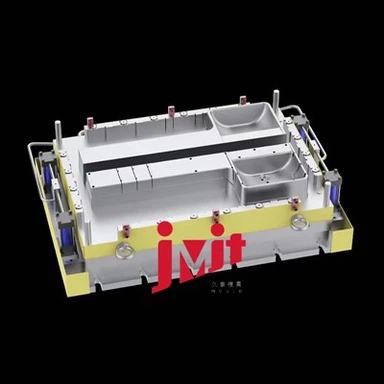
The Significant Advantages Of SMC Materials in Molds For Medical Magnetic Resonance Imaging (MRI) Enclosure
Oct 20, 2025
SMC (Sheet Molding Compound) in the Manufacturing of Medical Magnetic Resonance Imaging (MRI) Enclosure Molds
As a high-performance composite material, SMC (Sheet Molding Compound) demonstrates significant advantages in the manufacturing of molds for medical Magnetic Resonance Imaging (MRI) enclosures. Its core value is centered around the special application scenarios of MRI equipment (such as compatibility with strong magnetic fields, sterility requirements, and structural stability) and the industrialized needs of mold production (such as batch consistency and cost control). The following is a detailed analysis of its advantages from four key dimensions: material properties, mold performance, medical adaptability, and production economy.
I. Inherent Material Advantages: Meeting the Core Requirements of MRI Equipment
The core demands of MRI equipment for enclosures are "non-magnetic/low-magnetic, insulating, and stable". The inherent properties of SMC materials perfectly match these requirements, fundamentally addressing the pain points of traditional metal enclosures:
1.Completely Non-Magnetic, Avoiding Equipment Interference
SMC is composed of a resin matrix (e.g., unsaturated polyester resin), glass fiber reinforcement, and fillers, without any metal components (such as iron, nickel, or cobalt). Its magnetic permeability is close to that of air, so it does not generate magnetic eddy currents or magnetic field distortion in the strong magnetic field of MRI. This not only prevents interference with imaging accuracy (e.g., image artifacts) but also avoids heat generation and vibration of the enclosure caused by magnetic field effects, ensuring the stable operation of the equipment and patient safety.
In contrast to traditional metal enclosures (e.g., aluminum alloy, stainless steel): Metals cause magnetic interference and require additional "non-magnetic treatment" (which is costly and has limited effectiveness), while SMC can directly meet non-magnetic requirements.
2.Excellent Electrical Insulation, Ensuring the Safety of Medical Staff and Patients
MRI equipment involves high voltage and high-frequency signals during operation, so the enclosure must have reliable electrical insulation to prevent electric leakage. The volume resistivity of SMC can reach 10¹²-10¹⁴Ω・cm, and its breakdown voltage is ≥15kV/mm, which far exceeds the insulation standards for medical equipment. It can effectively isolate the internal circuit from the external contact environment, avoiding the risk of electric shock for medical staff and patients.
3.Low Thermal Conductivity + High Heat Resistance, Adapting to Equipment Heat Dissipation NeedsMRI equipment (e.g., gradient coils, radio frequency coils) generates heat during operation. The enclosure must balance "heat insulation" (preventing the enclosure surface from becoming too hot to scald patients) and "heat resistance" (withstanding the low-temperature heat environment inside the equipment for a long time without deformation). The thermal conductivity of SMC is only 0.2-0.3W/(m・K) (approximately 1/200 that of aluminum alloy), which can effectively block the transfer of internal heat to the surface. At the same time, its heat distortion temperature (HDT) can reach 120-180℃, allowing it to work stably in the internal environment of the equipment (50-60℃) for a long time without the risk of softening or cracking.

II. Mold Molding Advantages: Balancing Structural Complexity and Batch Consistency
Medical MRI enclosures are not simple "covers"-they usually include complex curved surfaces, grooves (for wiring and heat dissipation holes), and splicing interfaces (for adapting to the main body of the equipment). The molding process of SMC molds can efficiently meet these needs:
1.One-Time Molding of Complex Structures, Reducing Subsequent Processing
SMC adopts a "compression molding process": glass fiber sheets pre-impregnated with resin are placed into a precision mold, and then pressed and cured under high temperature (120-150℃) and high pressure (10-50MPa). This process can form complex enclosures with ribs, holes, and curved surfaces in one go, eliminating the need for multiple subsequent processing steps (such as welding, drilling, and grinding) required for metal enclosures. This not only reduces process costs but also avoids strength risks at welding seams and hygiene dead corners (which are prone to bacterial growth in medical scenarios).
2.High Dimensional Accuracy and Strong Batch Consistency
MRI enclosures need to fit precisely with internal components of the equipment (e.g., coils, magnets), requiring strict tolerance control (usually ±0.1mm). During SMC compression molding, the material has good fluidity in the mold and low curing shrinkage (only 0.2%-0.5%). Moreover, the mold itself is processed using high-precision CNC technology, which ensures highly consistent dimensions and shapes of enclosures in each batch, meeting the needs of industrialized mass production (the daily output of a single mold can reach 50-100 pieces).
3.Long Mold Service Life, Reducing Long-Term Costs
SMC materials have moderate hardness (Barcol hardness ≥40), causing minimal wear to the mold during molding. Meanwhile, molds are usually made of P20 or H13 mold steel, with their surfaces treated by nitriding (hardness ≥HRC50), resulting in excellent corrosion resistance and fatigue resistance. Under normal use, the service life of an SMC mold can reach 100,000-500,000 molding cycles, far exceeding that of plastic injection molds (usually 30,000-100,000 cycles). This can significantly amortize mold costs during long-term mass production.

III. Medical Scenario Adaptability Advantages: Meeting Sterility, Safety, and Durability Requirements
Enclosures for medical equipment must comply with strict medical certification standards (e.g., ISO 13485, FDA QSR 820). Enclosures produced by SMC molds perform exceptionally well in these aspects:
1.Easy-to-Clean Surface + Disinfection Resistance, Meeting Sterility Requirements
The surface of SMC compression-molded enclosures is smooth (roughness Ra ≤ 0.8μm), with no defects such as air holes or cracks, making it difficult for dust, body fluids, or medicinal liquids to remain. At the same time, it has strong chemical corrosion resistance and can withstand long-term wiping with common medical disinfectants (e.g., 75% alcohol, chlorine-containing disinfectants, hydrogen peroxide) without surface discoloration, cracking, or chemical migration (avoiding contamination of patients' skin), meeting the high-frequency disinfection needs of hospitals.
2.High Structural Strength + Impact Resistance, Ensuring Long-Term Durability
MRI equipment is large in size and heavy in weight (the single weight of an enclosure can reach 50-200kg), and it needs to be in a densely populated hospital environment for a long time. Therefore, the enclosure must have sufficient load-bearing capacity and impact resistance. The flexural strength of SMC materials can reach 120-180MPa, and the impact strength (simple beam) is ≥20kJ/m², far exceeding that of ordinary plastics (e.g., ABS, PP). It can withstand the hoisting force during equipment assembly and collisions during daily use, and is not prone to deformation or damage during long-term use (5-10 years).
3.Environmentally Friendly and Odorless, Complying with Medical Health Standards
SMC materials do not release volatile organic compounds (VOCs) during production, and do not produce toxic and harmful substances (e.g., formaldehyde, heavy metals) after curing. At the same time, their combustion performance meets UL94 V-0 level (no dripping during vertical combustion, self-extinguishing time ≤10s), which can reduce the generation of toxic smoke even in extreme cases, complying with the "non-toxic, low-smoke, flame-retardant" health and safety requirements for medical equipment.