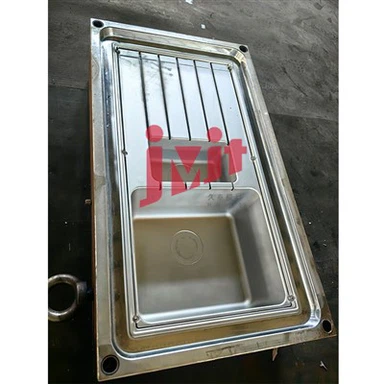
Melamine Bathroom Floor Mould
With the modern bathroom industry upgrading towards lightweight, integrated and durable products, the shower base, as a core functional component of the bathroom space, has seen continuous innovation in its materials and forming processes. Melamine resin, with its outstanding advantages such as...
- Fast Delievery
- Quality Assurance
- 24/7 Customer Service
Product Introduction
With the modern bathroom industry upgrading towards lightweight, integrated and durable products, the shower base, as a core functional component of the bathroom space, has seen continuous innovation in its materials and forming processes. Melamine resin, with its outstanding advantages such as high temperature resistance, water resistance, moisture-proofing, high strength and lightweight, has gradually become the preferred material for shower bases, with market demand continuously rising. The molds integrate material science, hot-pressing forming technology and precise mechanical design, focusing on solving core issues such as uniform curing, product deformation prevention, and surface texture replication during the melamine resin forming process. The key lies in the precise design of the integrated structure, anti-slip texture, drainage slope and temperature control system.

I. Material Properties and Forming Processes
1.Material advantages
Melamine resin (melamine formaldehyde resin): A thermosetting material that is insoluble and infusible after molding.
Core performance: Resistant to high temperatures (-20 to 100°C), water-resistant and moisture-proof, corrosion-resistant, smooth surface that is easy to clean, high strength, and impact-resistant.
Composite materials: Usually mixed with wood pulp, stone powder, and other fillers to enhance rigidity and dimensional stability.
2. Compression Molding Process
1. Material Preparation: Methylamine resin powder + filler + curing agent + pigment are mixed and dried.
2. Preheating: The mold is heated to 120-200℃.
3. Feeding: The mixed material is added to the cavity.
4. Closing the Mold and Hot Pressing: Pressing force of 300-2000 tons is applied, and the material is kept under heat and pressure for 1-10 minutes until fully cured.
5. Demolding: The mold is opened and the part is ejected, followed by trimming and polishing.

II. Key Points of Mold Structure Design
1. Overall Structure
- Single-cavity mold: The base size is large (commonly 1.2m × 1.0m), and a one-cavity mold is used.
- Parting surface: Set along the contour of the base's water-blocking edge to ensure no obvious parting line on the appearance.
- Mold base: Heavy-duty mold base, capable of withstanding high pressure, and commonly uses LKM standard mold base.
2. Core Functional Structures
- Anti-slip texture: The cavity surface is engraved with concave-convex patterns, leather patterns, and mosaic patterns to ensure anti-slip performance in both dry and wet conditions.
- Drainage slope: The mold has a built-in 1-2° tilt, with the center being lower and the periphery higher, guiding water to the floor drain.
- Water-blocking edge / rim: Integrated high edge, preventing water overflow, and no need for secondary installation.
- Floor drain hole position: Precisely positioned core-pulling mechanism (cylinder / inclined guide pin) to form the installation hole.
- Reinforcing ribs: Evenly distributed on the back to enhance strength, control wall thickness (3-5mm), and prevent deformation.
3. Temperature Control System
Heating method: Cartridge heaters are evenly distributed on both the male and female molds.
Temperature control accuracy: ± 5℃, ensuring full cross-linking and curing of the resin, with no under-molding or over-molding.
4. Ejection and Core Pulling
Ejection system: Pin + plate combination, providing uniform ejection over a large area, preventing white marks and deformation.
Core pulling mechanism: Hydraulic cylinder, suitable for complex side holes and undercuts, stable and reliable.
5. Steel and Surface
Cavity steel: H13 / 2344 hot work die steel, heat treated to HRC 48-52, wear-resistant and corrosion-resistant.
Surface treatment: Mirror polishing (Ra ≤ 0.8 μm) or texture etching, easy demolding and aesthetically pleasing products.

III. Mold Advantages and Product Features
Monolithic molding: Seamless and highly waterproof, superior to traditional ceramics / fiberglass reinforced plastics.
Lightweight: 50%+ lighter than ceramics, convenient for installation and transportation.
Durability: Resistant to aging, color change and cracking, with a long service life.
High production efficiency: Suitable for large-scale mass production, with a mold life of 300,000 to 500,000 cycles.
The melamine shower room base mold is a high-precision and advanced product in bathroom molds, integrating material science, hot pressing technology and precision machinery. Taizhou Huangyan Jiutai Mould Co., Ltd. ensures that the formed base is waterproof, anti-slip, durable and aesthetically pleasing through optimizing structure, temperature control and surface design, making it an ideal choice for modern bathroom upgrades.

Hot Tags: melamine bathroom floor mould, China melamine bathroom floor mould manufacturers, factory, mould for wearable devices, mould for natural materials, mould for boiling products, mould for medical supplies, mould for recyclable materials, mould for cycling products
No Information