



Injection Mold For Automotive Instrument Panel
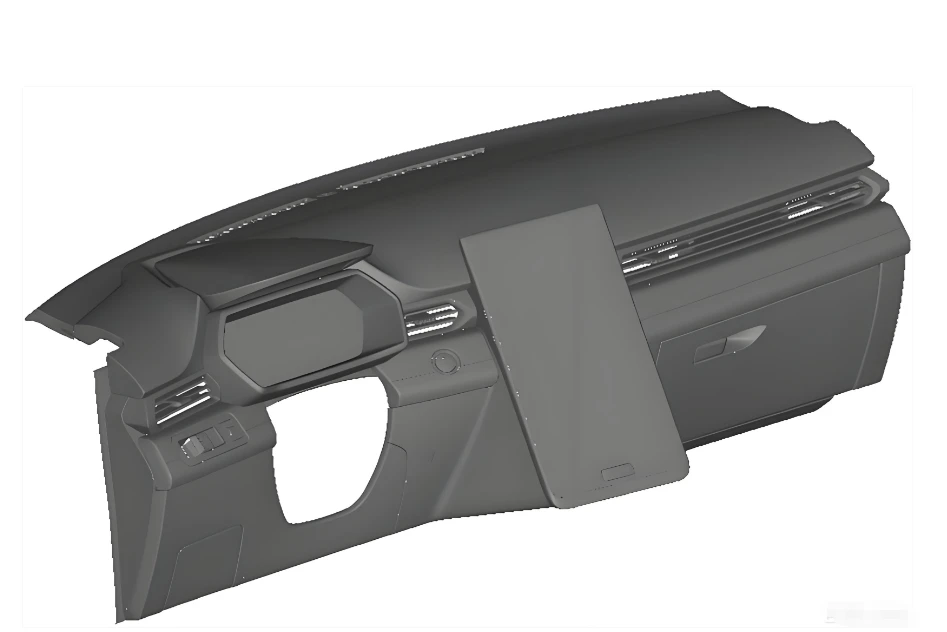
The dashboard of a car, as a core component of the car's interior, directly determines the vehicle's aesthetic quality, assembly accuracy, and user experience.
- Fast Delievery
- Quality Assurance
- 24/7 Customer Service
Product Introduction
The dashboard of a car, as a core component of the car's interior, directly determines the vehicle's aesthetic quality, assembly accuracy, and user experience. The injection mold for automotive dashboards is a key piece of equipment for achieving large-scale, high-precision mass production of dashboards. The following is a systematic and professional detailed analysis provided by Jiutai Mould for you.
The dashboard of a car, as a core component of the car's interior, directly determines the vehicle's aesthetic quality, assembly accuracy, and user experience. The injection mold for automotive dashboards is a key piece of equipment for achieving large-scale, high-precision mass production of dashboards. The following is a systematic and professional detailed analysis provided by Jiutai Mould for you.
I. Mold Characteristics
The injection mold for automotive dashboards, influenced by the product's own characteristics, exhibits core technical features of "large-scale, complex, and high-precision", specifically manifested as follows:
1. The large-scale structural features are prominent: The dashboard is a large interior plastic part of a car. The conventional external dimensions can reach over 1300mm×500mm×450mm, and the corresponding mold is also a large injection mold, featuring large external dimensions and heavy overall weight. During production, it needs to be matched with a large injection molding machine. The overall structural design of the mold must fully meet the stiffness and strength requirements of large-scale equipment to prevent mold deformation during the molding process.
2. The cavity structure is complex and precise: The surface of the dashboard needs to integrate multiple functional structures such as air outlet installation positions, display card slots, button recesses, and wire harness through holes, and there are many irregular lateral concave and convex structures, which leads to a long flow path and high flow resistance of the melt in the cavity. This poses extremely high requirements for the forming accuracy, surface finish and exhaust system design of the cavity.
3. Adapting to strict appearance requirements: As the dashboard is a core visible interior part in the vehicle, its surface often needs to be processed with textures such as leather grain and matte finish. Therefore, the mold cavity needs to be finely textured simultaneously. At the same time, to prevent damage to the surface texture during demolding, the demolding slope (usually ≥ 5°) must be strictly controlled to ensure the consistency of the appearance of mass-produced products.
4. High stability operation requirements: In industrialized mass production scenarios, molds need to withstand high-frequency opening and closing impacts. Therefore, strict requirements are imposed on indicators such as guiding and positioning accuracy, and the wear resistance of key components. It is necessary to ensure long-term stable operation of the molds through measures such as strengthening structural design and selecting wear-resistant materials, to guarantee production efficiency and product qualification rate.

II. Key Design Points
The mold design should comprehensively consider the three core goals of forming quality, production efficiency, and service life. The key design points are as follows:
1. Gate System Design
The hot runner gate system should be prioritized, and the integral hot runner structure is recommended. This structure has significant advantages such as convenient installation and disassembly, controllable manufacturing costs, and no risk of molten material leakage. When designing, the size and specifications of the dashboard and the melt flow characteristics should be combined to scientifically set the number and distribution of gates. Usually, a multi-point injection method is adopted to ensure uniform filling of the cavity by the melt and effectively reduce forming defects such as weld lines and shrinkage marks.
2. Side Core-pulling Structure Design
For the side concave-convex structures of the dashboard (such as side holes, bosses, etc.), the side core-pulling mechanism should be precisely designed. Common industry solutions include the combination of inclined sliders and springs, and the combination of bent pins and sliders. During the design process, the core-pulling stroke and driving force should be accurately calculated to ensure smooth and stable core-pulling actions, precise and reliable repositioning, and avoid interference with other mold structures to ensure smooth demolding of the product.
3. Cooling System Design
A "grid-like cross-cooling" design scheme is adopted. The moving mold usually has 12-15 straight-through cooling water channels and water well cooling circuits, while the fixed mold has 20-25 cooling circuits. The water channels of the moving and fixed molds are arranged in a cross pattern to form a uniform cooling network covering the entire area. This design ensures consistent cooling rates in all areas of the dashboard, effectively avoiding problems such as warpage and inconsistent shrinkage caused by uneven cooling, and shortening the forming cycle to improve production efficiency.
4. Guide and Positioning System Design
A combined guide and positioning structure of square guide pins and parting surface positioning pins is adopted. Square guide pins have the advantages of high guiding accuracy and strong load-bearing capacity. Combined with parting surface positioning pins, they can form a dual positioning guarantee, effectively avoiding problems such as offset and misalignment during mold opening and closing, ensuring the accuracy of cavity closure, and thereby improving the dimensional consistency of the product.
5. Venting System Design
Due to the large volume of the dashboard cavity and the long melt filling path, gas is likely to remain in the cavity during the forming process. Therefore, venting grooves should be precisely set in the key areas where the melt is last filled (such as corners and the roots of ribs). The width of the venting grooves should be controlled at 0.02-0.05mm, and the depth should not exceed 0.1mm to ensure the smooth discharge of gas from the cavity and avoid forming defects such as bubbles, burning, and material shortage.

III. Mold Materials
The selection of mold materials should comprehensively balance the wear resistance, polishing performance, structural strength and cost control. The selection criteria for core parts materials are as follows:
1.Cavity and core: Preferentially use pre-hardened plastic mold steels with high hardness and good polishing properties, such as 718H, NK80, P20H, etc. Their hardness can reach HRC30-40. This not only meets the requirements for processing fine textures of the cavity but also has excellent wear resistance, ensuring that the mold service life is ≥ 500,000 mold cycles. For high-end vehicle instrument panel molds, stainless steel mold steels with better corrosion resistance and polishing performance (such as S136H) can be selected to further improve the surface quality of the product.
2. Template-type parts: Basic templates such as fixed templates and movable templates should primarily use pre-hardened mold steels like P20 and 718 to ensure sufficient rigidity and strength, preventing structural deformation of the molds during frequent opening and closing operations; guide columns and guide sleeves should be made of alloy structural steels like 20CrMnTi. After carburizing and quenching treatment, their wear resistance and guiding accuracy can be significantly improved.
3. Parts of the ejector mechanism: The moving parts such as inclined sliders and bent pins should be made of cold-worked steel with high strength and wear resistance, such as Cr12MoV, SKD11, etc. After quenching and tempering treatment, their hardness can reach HRC55-60, ensuring the long-term stability and wear resistance reliability of the ejection action.
IV. Molding Process
The injection molding process for automotive instrument panels is based on the core principles of "high-precision parameter control and stable mass production". The related process information is summarized in the following table:
|
sorts of craftwork |
detailed description |
|
Core process parameter control |
1. Temperature parameters: ① Barrel temperature (for PP material: 180-220℃; for ABS material: 220-260℃), the temperature of each section needs to be precisely adjusted according to the characteristics of the raw materials to ensure uniform plasticization of the melt; ② Mold temperature: 40-80℃, the temperature is maintained stable through a constant temperature cooling system to avoid uneven shrinkage of the product due to temperature fluctuations; |
|
2. Pressure parameters: ① Injection pressure: 80 - 120 MPa. It adopts a segmented pressure application mode, using a gradient pressure regulation to reduce the risk of melt impact on the mold cavity, ensuring stable molding; ② Holding pressure: Set at 50 - 70% of the injection pressure, to ensure sufficient secondary filling of the mold cavity and reduce product shrinkage marks. |
|
|
3. Speed parameters: The injection speed range is 30 - 80 mm/s. A differentiated speed control strategy is adopted - for complex structural areas (such as holes and corners), a low-speed filling of 30 - 50 mm/s is used to ensure complete molding; for regular areas, a high-speed filling of 50 - 80 mm/s is employed to enhance production efficiency. |
|
|
4. Time parameters: ① Holding pressure time: 5 - 15 seconds, adjusted dynamically according to the product thickness to ensure adequate ejection; ② Cooling time: 10 - 25 seconds, with the core criterion being that the product is fully cured and there is no deformation after demolding. |
|
|
Molding process |
Raw material drying and pre-treatment → Barrel heating and plasticization → Injection filling the mold cavity → Hold pressure and retraction for filling → Cooling and solidification → Unmolding → Side core ejection action → Product ejection → Inspection of the removed part → Preparation for mold closing for the next molding (For high-end products, additional surface treatment processes such as spraying and flocking can be added later) |
|
Process Difficulties and Solutions |
1. Long melt flow path is prone to cause weld marks: This can be improved by optimizing the position and quantity of the gate, moderately increasing the barrel temperature, and precisely controlling the injection speed, etc. 2. Surface texture is prone to damage: Strictly control the demolding speed, optimize the layout of the ejection mechanism, ensure uniform distribution of the ejection force, and avoid local stress concentration that causes damage to the texture. |

V. Application Scenarios
Automotive instrument panel injection molds are widely used in the mass production process of instrument panels for various passenger vehicles and commercial vehicles. They cover all vehicle types including fuel vehicles and new energy vehicles (pure electric, hybrid). The specific application features are as follows:
1. Full vehicle model compatibility: Based on the specific requirements of different vehicle models' dashboard structures, customized mold structures can be designed to adapt to the production of various types of vehicles such as compact cars, SUVs, MPVs, and heavy-duty trucks. For instance, for the large-sized curved surface structure of the dashboard in SUV models and the integrated installation positions for full LCD screens in new energy vehicles, precise compatibility can be achieved.
2. Function Integration Adaptation: In line with the trend of automotive intelligence, the mold can simultaneously integrate functional areas such as the card slot for ambient lighting, the installation position for wireless charging module, and the sensor fixation structure, achieving "one mold forming, integrated integration", significantly reducing subsequent assembly processes and enhancing production efficiency and assembly accuracy.
3. Balancing high-end and low-end demands: For luxury vehicles, the molds can achieve high-precision texture forming and seamless joint structures, ensuring the appearance texture and assembly accuracy of the products. For mass-market vehicles, by optimizing the mold structure and simplifying the processing procedures, low-cost and high-volume production can be achieved to meet the large-scale market demands.
4. Industry Extension Application: After certain molds undergo targeted structural adjustments, they can be extended for use in automotive interior components such as the center console and the passenger seat storage box, which are structurally similar to the dashboard. This enhances the mold's versatility and reduces the production costs of the enterprise.
In conclusion, the design and production of automotive instrument panel injection molds need to comprehensively consider the product structure characteristics, material requirements of raw materials, molding process parameters, and market application scenarios. Through precise structural design, scientific material selection, and strict process control, the instrument panel can achieve high precision and stable batch production, fully meeting the strict quality standards and market demands of the automotive industry for interior components.
Hot Tags: injection mold for automotive instrument panel, China injection mold for automotive instrument panel manufacturers, factory, ce marked injection mould, advanced injection mould, plastic injection mold supplier, domestic injection mould market, custom injection mould, injection mould shipping


