SMC Composites Link Up With The New Energy Wave
Aug 25, 2026
Driven by the core trends of lightweight, safe, and integrated development in new energy vehicles, SMC (Sheet Molding Compound), with its multiple core advantages such lightweight and high strength, insulation and flame retardancy, integral molding, and corrosion and weather resistance, continues to replace traditional metal materials and has become a key composite material for lightweight upgrading the new energy field. The SMC industry is embracing multiple dividends including large-scale implementation, intelligent production, and technological breakthroughs, comprehensively covering emerging sectors such as new energy passenger vehicles commercial vehicles, rail transit, and energy storage. The industry scale continues to expand, and the industrial landscape is accelerating its optimization.
I. Core Advantages of the Material
Compared with traditional steel and aluminum alloy components, SMC delivers compelling lightweight performance. Its density is merely one‑quarter that of steel and two‑thirds that of aluminum alloy. When adopted for battery pack housings, it achieves a weight reduction of 25%‑35%, effectively offsetting the dead weight of batteries in new‑energy vehicles and boosting driving range by 8%-10%. Meanwhile, SMC achieves UL94 V‑0 halogen‑free flame‑retardant grade and possesses high‑voltage insulation capacity. In the event of battery thermal runaway, it can effectively retard flame spread and greatly enhance overall vehicle safety.
Furthermore, its one‑shot compression‑molding process allows the integration of mounting supports, sealing grooves, flow‑guiding structures and other multi‑functional features. This cuts assembly procedures by over 30%, satisfies OEM requirements for mass production at the ten‑thousand‑unit level, and delivers combined benefits of lightweighting, enhanced safety, cost reduction and higher efficiency.
II. Expanding Market Scale
Spurred by new-energy passenger vehicles, new-energy commercial vehicles and energy-storage equipment, the automotive supporting market for SMC composite materials keeps growing. Industry statistics indicate that orders for SMC automotive molds rose 18% year-on-year, with the new-energy sector contributing most of the incremental demand. SMC structural components see rising penetration among new-energy models. SMC battery-pack upper covers, energy-storage enclosures, integrated chassis parts and spoilers represent its major application scenarios. Versus steel, SMC components attain 30%-40% weight reduction while offering insulation, corrosion resistance and flame retardancy. They directly improve battery safety performance and help extend vehicle driving range.
In the passenger vehicle sector, major automakers continue to expand their procurement of SMC components, with glass fiber reinforced SMC achieving large-scale vehicle installation, and carbon hybrid CF-SMC starting to be implemented in small batches for high-end models, while the average SMC usage per vehicle continues to rise. The energy storage track has become the growth curve, with SMC being used for energy storage battery boxes and inverter housings to balance protection and lightweighting, opening up incremental markets beyond the automotive industry.
Apart from battery systems for passenger vehicles, new-energy commercial vehicles constitute a blue-ocean incremental market for SMC. New-energy heavy‑duty and light-duty trucks are rapidly updated and popularized. Traditional steel bumpers and exterior trims suffer notable drawbacks: heavy weight, susceptibility to rust and short service life, which accelerates their replacement by SMC exterior structural parts.
SMC commercial‑vehicle bumpers achieve 35%‑45% weight reduction with a service life of 8‑10 years. Benefiting from high design flexibility, they fit the brand‑new styling language of new‑energy commercial vehicles, simplify manufacturing workflows and lower long‑term vehicle operation and maintenance costs. SMC has become a preferred option for lightweight upgrades of commercial vehicles.

III. Technological Breakthroughs in SMC Materials
Ongoing technical iteration fuels industrial upgrading. Multiple new‑generation SMC materials have been industrialized and trialed in small‑batch vehicle installations. The performance of conventional short‑chopped glass-fiber SMC is continuously optimized. Long‑fiber‑reinforced LFT-SMC, with superior mechanical performance, now accounts for 41.3% of SMC materials used in new-energy vehicles. It is widely applied in critical load-bearing components such as battery‑pack structural beams and chassis subframes.
Carbon‑glass hybrid CF‑SMC has achieved technical leaps with substantially improved strength and modulus and is undergoing small‑batch fitting on flagship high‑end vehicles. Moreover, major progress has been made on the long‑standing industry challenge of thermoset SMC recycling. Domestic large-scale closed-loop production lines for SMC process scraps have been built. When recycled material makes up 25% of the formulation, the drop in mechanical properties can be limited to within 4.3%. This recycled material has obtained certification from leading battery manufacturers and can be reliably used for structural components including battery supports, facilitating the green and low-carbon transformation of the industry.
IV. Technological Upgrading in the Mold Industry
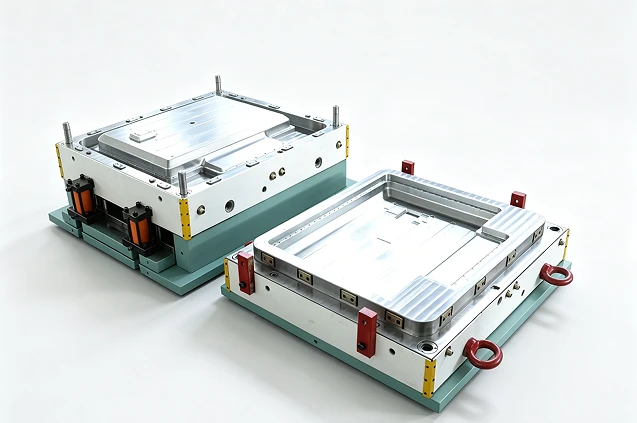
As new energy vehicle models upgrade towards larger, integrated, and consolidated designs, the molding quality and stability of SMC products highly depend on mold design and manufacturing; integrated components such as battery housings and large exterior panels impose stringent standards on mold precision, temperature control, structural stability, and service life. At present, uniform mold temperature control, venting and shearing, rigidity and stability of large-sized cavities, long cycle life, and short molding cycles have become the core evaluation indicators for new energy SMC molds, driving the mold industry iterative upgrades in high precision and high efficiency.
Pre-simulation enables refined mold optimization. CAE simulation is widely adopted in the industry. At the design phase, full-domain simulation of resin flow, stress distribution and heat conduction is performed in advance. Targeted optimizations are carried out for parting-face geometry, venting-system layout and thermal-oil temperature-control circuits. Potential mass-production defects including material scorching, local short shots, excessive flash and dimensional deviation are prevented upfront. This not only greatly shortens project lead-time and reduces subsequent mold-modification costs, but also delivers balanced mold-temperature control within ±1 °C, reliably meeting high-level requirements for IP68 ingress protection and UL94 V-0 flame retardancy.
Diversified molding processes develop in parallel. Multiple processes including conventional SMC compression molding, HP‑RTM and PCM coexist in the industry. Among them, demand for HP‑RTM molds for battery housings grows most rapidly. By optimizing internal cooling‑water channels and parting‑face structures, molding cycle time is reduced from 8 minutes to 6.5 minutes, lifting single‑line production efficiency by 23% with prominent advantages for high‑volume manufacturing.
The competitive strengths of industrial clusters keep growing. The precision-mold industrial cluster centered in Huangyan, Taizhou, has established a full-value-chain service system covering mold R&D and design, high-speed CNC precision machining, accurate trial molding and post-production laser-cladding repair. JMJT MOULD CHINA leverages its strengths of short delivery cycles, high cost-effectiveness and fast iterative services to secure continuous orders for high-precision SMC molds. It provides robust supply‑chain support for the industrial roll-out of lightweight new‑energy composite components across China.
Industry insiders comment that with sustained rapid expansion of new-energy vehicles, advanced energy-storage and rail-transport sectors, together with continuous breakthroughs in material and processing technologies, the market penetration of SMC composite materials will keep rising. In the future, SMC will function as a core enabling material for lightweight, safe and eco-friendly development in the new-energy arena and continue to generate substantial industrial value.