LFT Molding Tray Mold Process Characteristics
May 27, 2026
LFT compression molding tooling is a high-pressure, closed-mold system specifically designed for long-fiber-reinforced thermoplastic materials (LFT/LFT-D). Unlike traditional SMC thermoset compression molds or conventional injection molds, this technology leverages the unique properties of long-fiber thermoplastics-such as meltability, reworkability, and high toughness-combined with a low-pressure, slow-speed, full-compaction, and rapid-cooling molding process. It enables mass production of large-sized, highly durable, impact-resistant, and recyclable industrial pallets, making it ideal for logistics handling, automated warehousing, heavy-duty stacking, and low-temperature applications.
1. Dedicated Long-Fiber Protection Mechanism Ensures Superior Toughness and Impact Resistance
The core value of LFT materials lies in preserving intact long glass fiber structures. Conventional injection molds rely on high-speed screw shearing and high-pressure injection, which severely cuts fibers, significantly reducing product strength and toughness. In contrast, LFT compression molds feature open cavities and no high-shear flow channels, allowing fully melted material chunks to be placed directly into the cavity. Slow, uniform pressure ensures even filling, maximizing retention of 3–12 mm fiber length with consistent fiber orientation and excellent interlacing. The resulting pallets exhibit far superior impact resistance, bending strength, and fatigue resistance compared to short-fiber injection pallets, effectively solving common issues such as brittleness, breakage under heavy loads, and performance failure at low temperatures. This solution delivers both high load-bearing capacity and exceptional toughness.
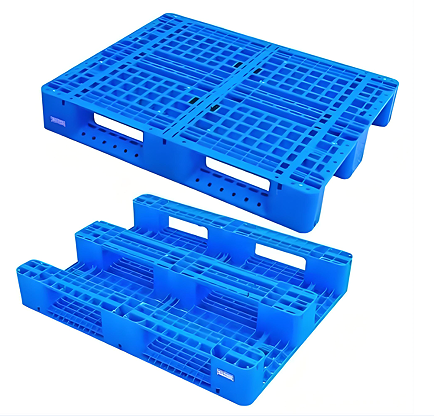
2. Thermoplastic Molding Process Enables High Efficiency and Recyclability
Unlike SMC thermoset compression molding, which requires prolonged constant-temperature curing and irreversible solidification, LFT is a thermoplastic material. LFT compression molds employ a "high-temperature melting + rapid water cooling" process, eliminating the need for extended curing cycles. Integrated balanced cooling water circuits ensure uniform heat exchange across the entire mold surface, drastically reducing cycle time-standard pallet cycles can be shortened to 60–90 seconds, significantly outperforming traditional composite molding processes. Defective products and trim scraps can be remelted and reused, eliminating permanent material waste. This supports green manufacturing and cost-effective mass production, making it the core forming technology for recyclable pallets.
3. Stable Large-Panel Molding with Low Stress and No Warpage
Designed for large-format logistics pallets measuring 1.2m to 1.6m, LFT compression molds use an evenly distributed pressure structure that uniformly covers the entire cavity surface. Material spreads passively and fills the mold without the localized high pressure, uneven flow velocity, or internal stress concentration typical of injection molding. Combined with zoned cooling and temperature control, the mold ensures consistent thickness shrinkage across the panel, effectively preventing warping, sinking, twisting, and edge deformation commonly seen in large parts. The finished pallets offer excellent flatness, stack neatly, and fit precisely on shelves, meeting the high-precision requirements of automated warehouses and conveyor systems.
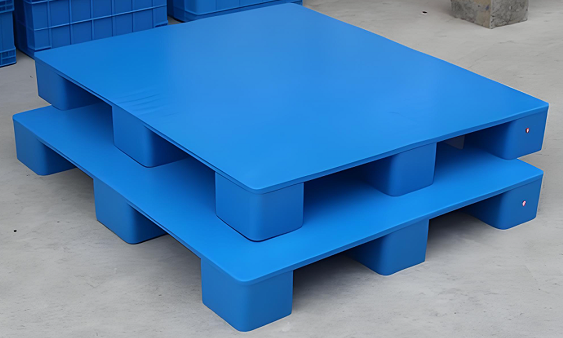
4. Simplified, Reliable Mold Design Suited for High-Pressure, Low-Speed Compression
LFT compression pallet molds eliminate the need for complex hot runner systems, multi-point gating, or precision core-pulling mechanisms used in injection molds. Instead, they adopt a robust, single-piece thick-plate construction with quenched and tempered steel, providing high cavity strength and excellent pressure resistance. The mold can reliably withstand sustained, uniform compression pressures of 8–12 MPa over long periods. With no fragile inserts or complicated transmission components, the mold operates with extremely low failure rates, resists high-pressure impacts, and endures repeated opening and closing without significant wear or deformation. Routine maintenance includes simple cleaning and rust prevention, minimizing downtime and ensuring stable operation. Mold lifespan typically exceeds 800,000 cycles, delivering outstanding long-term production reliability.
5. Broad Process Compatibility and Rapid Performance Customization
LFT compression molds are compatible with two mainstream production methods: LFT pellet feeding and direct in-line mixing of LFT-D. They support various thermoplastic matrices including PP and PA, and allow flexible addition of modifiers such as flame retardants, anti-static agents, low-temperature resistance additives, UV stabilizers, and toughening agents, enabling rapid customization of performance characteristics. By leveraging precisely adjustable pressure, temperature, and holding pressure parameters in the mold, combined with a simple insert replacement structure, this process enables rapid production of various types of pallets-including standard turnover pallets, heavy-duty shelving pallets, anti-static electronic pallets, low-temperature cold chain pallets, and outdoor weather-resistant pallets. With flexible formula adjustments and fast product iteration, it meets diverse customization needs across multiple industries.
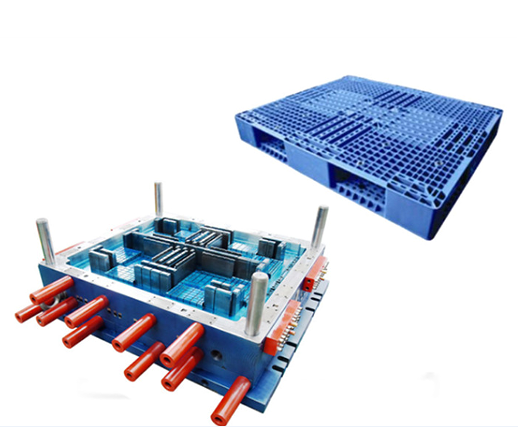
6. High Yield Rate and Simplified Post-Processing
LFT compression molding ensures uniform pressure and smooth venting during closed-mold forming, resulting in products free from defects such as bubbles, voids, delamination, or weld lines. The surface is dense, flat, and features clean, well-defined edges. Compared to SMC molding, which requires sanding and removal of cured flash, and large-scale injection molding, which often suffers from shrinkage flaws, LFT molded parts require only minimal trimming after forming-eliminating the need for secondary processes like polishing, curing, or repairs. This significantly reduces labor and post-processing costs, achieving high yield rates suitable for large-scale, efficient mass production.
7. Controllable Overall Production Cost and Outstanding Cost-Performance for Mass Production
Large-format LFT pallet molds feature simple structures and low machining complexity, resulting in much lower initial tooling investment compared to similarly sized large injection molds. Additionally, the LFT compression molding process generates no runner or sprue waste, achieves high raw material utilization, and allows thermoplastic materials to be recycled, minimizing material loss. Combined with short cycle times, low maintenance requirements, and high yield rates, this technology delivers significantly lower overall production costs than injection molding and traditional thermoset compression molding when manufacturing large, heavy-duty, and highly durable logistics pallets in volume, offering clear advantages in cost-effectiveness for mass production.