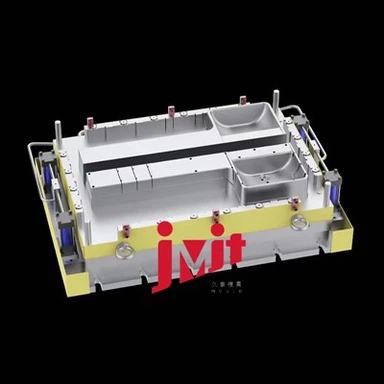
Key Technical Points Of GMT Automotive Molding Tooling
Sep 09, 2026
Thermoplastic GMT glass fiber mat-reinforced composites, with their outstanding advantages of lightweight, impact resistance, and recyclability, have been widely applied in large structural components for new energy vehicles, such as battery shields, underbody protectors, and front-end modules. Unlike the traditional thermoset SMC compression molding process, GMT molding employs a process route involving external preheating of the sheet material and mold cooling for shaping, which imposes special requirements on tooling rigidity, temperature control systems, shear structures, and automation compatibility. This paper focuses on large automotive GMT components and presents the structural design of thermoplastic molding tools, key points of temperature control, common issues, and corresponding process optimization solutions.
I. Overall structure of the work fixture (large automotive parts)
1. Formwork frame body
Material: P20 / 718H hardened steel with HRC30 - 36 hardness. Thickened frame and back reinforcement ribs to withstand 10 - 20 MPa high pressure and prevent large-sized molds from deforming due to pressure.
Mold cavity surface is polished with Ra0.8 - 1.6 μm; draft angle is 3° - 5° to prevent surface scratches during demolding of large parts; precision guide pins and guide sleeves + positioning pins to control the closing gap and suppress flash.
Shearing edge: Stretchable vertical shearing edge structure, direct shearing inside the mold, reducing the subsequent trimming process and controlling the thickness of the flash.
· Ejection system: Multi-point synchronous ejection, preventing warping during ejection of large-sized parts; can be integrated with vacuum exhaust to improve surface quality.
2. Thermal management system [The core of GMT tooling]
The main difference between GMT and SMC: SMC molds are continuously heated; GMT work fixtures are mainly for cooling.
1. Partitioned high-flow deep-hole cooling water circuit (essential for large parts)
For large pieces over one meter in size, the cooling rate differences in different wall thicknesses and rib positions can easily cause residual stress and warping deformation; using partitioned independent temperature control, key areas can be made to perform conformal cooling, achieving balanced heat dissipation, and ensuring dimensional stability.
1. Local auxiliary heating: Electric heating tubes can be configured in the embedded part installation area and thick rib areas to avoid premature cooling and material shortage.
Mold working temperature: 60 - 90℃; Preheating outside the sheet material furnace: 170 - 190℃,strictly prohibit exceeding 230℃, to prevent degradation of the PP matrix.
3. Automated adaptation interface
· Reserved material handling interface for the mechanical hand and sheet positioning limit blocks;
· Integrated oil circuit and air circuit; compatible with hydraulic press tonnage: 1600 - 4000t large hydraulic press.

II. Key Features of Typical Automotive GMT Components and Tooling
|
GMT parts |
Key points of workwear design |
|
Battery pack protective cover |
Large-area flat plate + dense reinforcing ribs; zone cooling; high rigidity mold frame; multiple protrusions for installation; in-mold trimming |
|
Car underbody guard plate |
High aspect ratio, thin wall; control warping; vacuum exhaust; low flange |
|
Front-end module bracket |
Multiple embedded parts; complex concavities and convexities; controlling material flow, protecting fibers from excessive shearing |
|
anti-collision beam |
Thick-section structural components; Adequate pressure retention; Balanced cooling to ensure impact performance |
III. Key Differences between GMT Tooling and SMC Tooling
|
project |
Thermoplastic GMT tooling |
Thermosetting SMC tooling |
|
Molding principle |
The sheet material is preheated outside the furnace, and the mold cools and solidifies (physical phase change) |
The mold is continuously heated, and the resin undergoes chemical curing and cross-linking. |
|
temperature control system |
Mainly using zone cooling |
Continuous heating (hot oil / electric heating) |
|
molding cycle |
45-90 s |
3-6 min |
|
material recycling |
The components can be crushed and reused. |
unrecyclable |
|
Failure risk |
Cold and hot cycle fatigue, waterway blockage, blade edge wear |
High-temperature oxidation corrosion |
IV. Common Failures of Large-scale GMT Tools & Design Avoidance Measures
Part warping, dimension deviation:The root cause is uneven cooling; solutions: divided cooling, shaped water channels, optimization of wall thickness difference, reasonable allowance for shrinkage.
Disorder in fiber flow and insufficient local strength:Limitation of raw material placement; Segmented control of mold closing speed to prevent fibers from being severely washed away and displaced.
Excessive flying edge:Enhance the rigidity of the mold frame; improve the positioning accuracy of the guide columns; optimize the gap of the shearing blades
.Sharp edge rapidly wears down:Local quenching hardening of the cutting edge.
Demolding deformation:Perform multiple synchronous extrusions and set an appropriate draft angle for the mold.

V. Complete GMT Molding Process Flow
Cutting of GMT sheet material → Preheating in hot air oven at 170 - 190℃ → Automatic hand quickly feeds the material into the workpiece cavity → Rapid closure of the hydraulic press → High-pressure holding (10 - 20 MPa) → Cooling and shaping inside the mold → Internal shearing and trimming → Synchronous ejection → Removal of the part and entry into the next cycle.