China Carbon Fiber Market Outlook
Nov 12, 2024
Core Tip: As the CW seeks to form a holistic view of the state of the global carbon fiber market, a better understanding of the statistics, trends and observations of carbon fiber in China is becoming increasinglynecessary. The 70-page report written by Lin, which focuses on the carbon fiber market between 2022 and 2023, attempts to open up the topic. The CW provides a brief overview here of the key discussions, points of view and conclusions that emerged from Lin's research, with commentary from other sources to provide context and perspective.

Figures 1a and 1b. Carbon fiber demand in China in 2023 (by use) in metric tons (left); 2023 China and global carbon fiber demand by use, in kilotons (right). All photos by | Gang Lin
As the CW seeks to form a holistic view of the state of the global carbon fiber market, it is becomingincreasingly necessary to better understand the statistics, trends and observations of carbon fiber in China.
The 70-page report written by Lin, which focuses on the carbon fiber market between 2022 and 2023, attempts to open up the topic. The CW provides a brief overview here of the key discussions, points of view and conclusions that emerged from Lin's research, with commentary from other sources to provide context and perspective.
China Carbon Fiber profile
Not all carbon fiber is created equal. Differences in modulus, tow size, and other characteristics affect which carbon fiber types are dominant in certain end markets. For example, applications such as wind turbines use mid-end carbon fiber grades from T300 to T700 (Toray, Tokyo, Japan), while aircraft use high-end grades such as T800 and T1200G carbon fiber.


Figures 2a and 2b. Demand and application of CFRP in China in 2023 (metric tons) (top) and revenue of CFRP in China (billion yuan/RMB) (bottom).
It is understood that the overall level of carbon fiber in China is on par with the rest of the world. According to Lin's report, China's carbon fiber manufacturers have proven their strength in mastering already mature material technology, which has allowed China's carbon fiber to gain a certain share in wind energy, industrial, automotive and other markets. However, as suggested by some of his discourse, China is weaker in the production of carbon fiber for high-performance aerospace structures (see Figures 1a and 1b) - an end market with more demanding requirements and regulations, so long experience is needed, but other players around the world are producing large quantities of high-performance carbon fiber (such as the T800 and T1200G models).
For example, Lin reports that the global aerospace "application capacity" - that is, the global supply of carbon fiber in specific end markets - is about 22,000 metric tons, while China lags behind at about 7,000 metric tons.
These figures are further reflected in Lin's breakdown of China's carbon fiber production versus market revenue (Figures 2a and 2b). While 47.8 percent of China's 2023 revenue is mainly from aerospace, including drones and defense (Figure 3), both of which are large consumers, the sales volume of carbon fiber reinforced plastics shows that aerospace has only 11.6 percent demand, ranking fourth; In both cases, sports/leisure and wind power still rank in the top three.
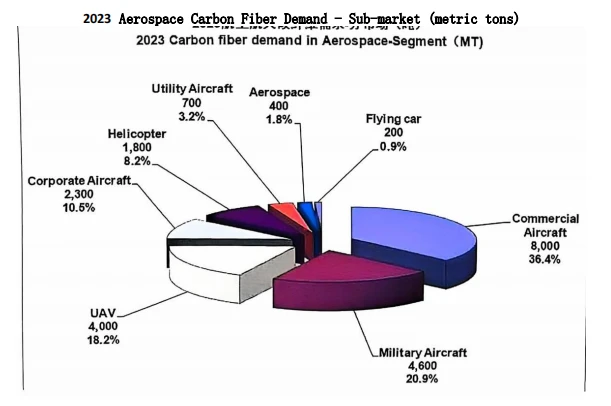
Figure 3. Global carbon fiber demand for aerospace in 2023 (metric tons)
As capacity increases, demand decreases

Figure 4. Global carbon fiber demand (thousand tons)
Global carbon fiber production demand across all end markets suggests that demand will grow exponentially through 2030, reaching about 280,000 metric tons assuming this trend continues (Figure 3), Lin said. This outlook is supported by global data obtained by advanced materials M&A specialist Future Materials Group (FMG, Cambridge, UK), which mirrors Lin's report. According to FMG, the global demand for carbon fiber over the past few years
is as follows:
2021:115,000 tonnes
2022:120,000 tonnes
2023:140,000 tonnes
FMG differs from the report in that Lin sees a decline in both global and Chinese demand for carbon fiber at the moment. Lin reported a 14.8 percent reduction in global carbon fiber demand between 2022 and 2023 (2022:135,000 metric tons, 2023:115,000 metric tons) and a 25.7 percent reduction in China (2022:74,429 metric tons,2023:69,075 metric tons).
FMG manager Myriam Yagoubi believes the difference could lie in the wind energy industry. She explained: "While [global] demand growth slowed between 2021 and 2022, it has now picked up again. "I think our main difference is the global demand for wind energy. Our view [outside China] is more positive, especially demand from Western wind Oems.
Lin and Yagoubi also talked about revenue loss from 2022 to 2023. Lim reported a 12.3 per cent reduction in global revenue (2022: $26.61 billion, 2023: $22.96 billion). Yagoubi opine: "2022 is a difficult year. Wind power demand is down and other markets are slowing, but this comes against the backdrop of strong demand for COVID-19, so the change in momentum is strongly felt by the industry. Of course, the extraordinary demand seen through COVID (and the associated price increases) cannot be sustained. All in all, FMG finds that global demand is still continuing to grow at a rate that is fairly close to history (7%-10%).
So it might make more sense to consider that global demand isn't abating - but China's is. Lin's data show that in the past few years, China has far outpaced its competitors in carbon fiber production, accounting for almost half of global capacity (Figure 4). But at the same time, China's carbon fiber demand has declined.
2023 Global Carbon Fiber Operating Capacity and Expansion Plan -- Manufacturer (thousand tons)
2023 Global CF Operation Capacities & Expansion plan by Manufacturer (Kllo-ton))

Figure 5.Global carbon fiber operation, capacity, and expansion by manufacturer in 2023. By comparison, the annual demand growth rate in China for 2021-2023 in Lin's report is:
2021:27.7%
2022:19.3%
: 2023-7.2%
Conversely, China ranks first globally in terms of operational capacity over the same period (Figure 5)
2021:30.5%
2022:43.3%
2023:47.7%
China's production capacity in 2023 is said to reach 138,330 metric tons, 26,280 metric tons more than in 2022, according to Lin. In this scenario, Lin expects "bloodbath in prices and high inventories". The report pointed to several potential reasons for the shift.
The effects of COVID-19 are still being felt, impacting both stocks and demand. Most carbon fiber producers (excluding Japan) saw their prices fall between 2022-2023. According to Lin, the price of carbon fiber producers in China dropped from an average of US $33 / kg in 2022 to US $18 / kg in 2023 (Figure 6).

Figure 6.Carbon fiber demand in China by unit price (US $/ kg), 2015-2023.
It is also important to study carbon fiber consumer markets in other countries in comparison to China. Each country has its own end-market specialization based on the grade of carbon fiber it offers. Lin noted that China's major markets include wind energy, sports/leisure, carbon-carbon (C/C) composites, construction and electronics, among which automotive applications have great potential (Figure 1a).
In contrast, carbon fiber supply from countries such as Japan, Europe and the United States is more prevalent in the pressure vessel and aerospace markets - not only do they account for 31.3 percent of global carbon fiber demand, but these regions have "deeper cooperation and more well-developed demonstrations in these application areas compared to China". This creates a "closed-loop industrial chain", although China's recent launch of the Commercial Aircraft Corporation of China (COMAC) C919 demonstrates the region's determination to regain its footing in the commercial aircraft sector.
It is worth noting that the aerospace market, which took a batting start in 2020, has been in a state of rapid recovery since 2023, and the pressure vessel market has also shown relative stability. This is in contrast to carbon/carbon composites, which Lin noted have seen falling prices, weaker demand for wind energy and a sharp drop in sales in the sports/leisure market after strong growth during COVID-19 in 2020.
The global market, imports have decreased
Beyond the numbers, Lin believes that the current carbon fiber supply situation in China - and even the world - can be attributed to two key factors: the international community's lack of understanding of Chinese carbon fiber manufacturers and geopolitical tensions.
The report generally considers Chinese products (such as textiles, toys, household goods, etc.) to be "cheap and good quality" and "enjoy a wide international reputation". However, when it comes to products with higher technology content, especially advanced materials such as carbon fiber and composites, the region is overlooked or ignored. And for those companies outside China that use Chinese carbon fiber, it may simply be out of necessity, not a need.

Figure 7.Carbon fiber demand in China (metric tons), 2008-2025, broken down into domestic production and imports.
"China's carbon fiber has made great progress in the past decade," Lin noted, "but has now caught up with the era when the market was short of supply and prices were high." In other words, China's carbon fiber production has eliminated the problem of insufficient domestic fiber supply, but Chinese carbon fiber producers have lost the ability to maintain relatively high prices.
As Figure 7 shows, in the past few years, China's domestic carbon fiber production has indeed grown substantially, while imported carbon fiber has declined. Since 2022, domestic carbon fiber has become the dominant supply in the Chinese market - and if the trend continues, it will be the only supply in China in the next few years. Customs data confirms this once again, showing that the volume of carbon fiber exported from China is negligible. The sharp drop in imports is said to be mainly due to what Lin called "enhanced import substitution of domestic carbon fiber and the development of the Chinese market that is not as expected".
Geopolitical tensions are also a factor. U.S. tariffs on Chinese carbon fiber, China's ongoing relationship with Russia and the love-hate entanglements between China and Taiwan have made it difficult for actual and potential carbon fiber customers outside the Chinese mainland to trust Chinese manufacturers with a sustained supply of carbon fiber.
"This has prompted Western customers to start assessing the risk" of Chinese carbon fiber, he said. "China's carbon fiber industry has done a good job in developing high performance, low price carbon fiber to help customers expand their applications. However, China's severe overcapacity and its internalization (a Chinese term that can be translated as' race to the bottom ', leading to the metamorphosis of an industry plagued by excessive competition) are not good for the world and could bring serious complications to decades of carbon fiber market development. "Should other regions embrace or cut their ties with Chinese carbon fiber? It's a big headache for the world."
The road ahead for China and the global carbon fiber market "The Chinese market is characterized by comprehensive and low-cost manufacturing capabilities," Lin said.
For [some] application markets with [mature products] [Figure 8], we have become the strongest in the industry, such as sports equipment, wind pultrusion boards, C/C composites, etc. Of course, this is also a double-edged sword - the business that makes China profitable in a few years can also experience wild swings. We seriously lack the ability and patience to explore new application ecosystems, which is the biggest difference and gap
compared to Europe, Japan and the United States."

Figure 8.2023 Global CFRP demand by process (kilo-tons).
Based on the data, Lin said that "capacity expansion or new construction (of carbon fiber production lines), overcapacity and fierce competition" will undoubtedly be the major challenges facing the industry in the coming years, not only in China but globally. Still, factors such as supply chain challenges
brought on by COVID-19 will gradually be addressed by the market
It will also recover. "Carbon fiber manufacturers should be patient," Lin added. Under such circumstances, how does Lin think Chinese carbon fiber suppliers should ensure the healthy and sustainable development of the industry?
Efforts to bring China into the international carbon fiber supply chain. He advised suppliers to continue to actively expand into other application areas by developing an "innovative ecological chain". Lin suggested that Chinese carbon fiber suppliers should not only explore the domestic innovation industry chain, but also actively participate in the construction of an international innovation ecosystem.
Seek mutual learning and consensus through professional cooperation and public development among China's top 10 enterprises, otherwise they will face the risk of overall losses in the carbon fiber supply chain as a whole. Lin stressed that Chinese companies should focus their main efforts on "technology research and development to reduce (carbon fiber) costs, improve efficiency and stabilize quality".
Uncertain market demand, technological innovations and increased production capacity will inevitably lead to an "industry shakeout", and Lim acknowledged that some of these challenges have also spurred new investors into the composites sector. However, he said nothing can be achieved
overnight and it requires a lot of patience, tolerance, resilience and perseverance.